

Robotics & Automation in IVF Labs
The world of in vitro fertilisation (IVF) is undergoing a technological revolution, one that’s redefining how fertility specialists approach conception. From precision-controlled robotic arms to AI-powered embryo analysis, robotics and automation in IVF labs are transforming what was once a delicate manual process into a high-efficiency, data-driven, and error-free system.
This evolution isn’t just about advanced machines; it’s about enhancing success rates, improving accuracy, and giving couples around the world new hope in their fertility journey.
In this blog, we’ll explore how robotics and automation are shaping modern IVF labs, their benefits, breakthroughs, and the future they promise.
1. The Evolution of IVF: From Manual to Machine-Assisted Precision

When the world’s first “test-tube baby,” Louise Brown, was born in 1978, IVF was purely manual. Every step, from egg retrieval to sperm injection, relied on the embryologist’s steady hands and trained eyes.
But fast forward to today, and the scenario is changing dramatically. Modern IVF labs are integrating robotics, AI, and machine learning to handle delicate operations like embryo handling, sperm selection, and even embryo transfer.
The shift isn’t replacing humans; it’s enhancing human expertise with technological precision, ensuring more consistent and reproducible outcomes.
2. Why IVF Needs Automation
IVF success depends on microscopic precision, time-sensitive procedures, and error-free conditions. Even the slightest variation in handling or temperature can affect fertilisation and embryo development.
Traditional IVF techniques, though effective, are prone to:
- Human error during micromanipulation
- Inconsistencies between embryologists’ skill levels
- Contamination risks from manual handling
- Limited scalability due to the manual nature of processes
That’s where automation steps in, creating a controlled, replicable environment that ensures accuracy and reduces variability.
3. Robotics in IVF Labs: How They Work
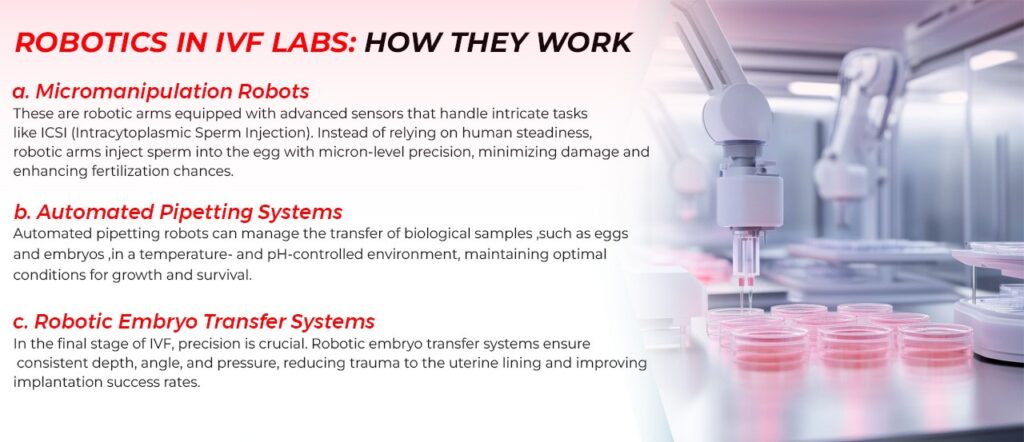
a. Micromanipulation Robots
These are robotic arms equipped with advanced sensors that handle intricate tasks like ICSI (Intracytoplasmic Sperm Injection). Instead of relying on human steadiness, robotic arms inject sperm into the egg with micron-level precision, minimising damage and enhancing fertilisation chances.
b. Automated Pipetting Systems
Automated pipetting robots can manage the transfer of biological samples, such as eggs and embryos, in a temperature- and pH-controlled environment, maintaining optimal conditions for growth and survival.
c. Robotic Embryo Transfer Systems
In the final stage of IVF, precision is crucial. Robotic embryo transfer systems ensure consistent depth, angle, and pressure, reducing trauma to the uterine lining and improving implantation success rates.
4. Automation in Embryo Culture and Monitoring
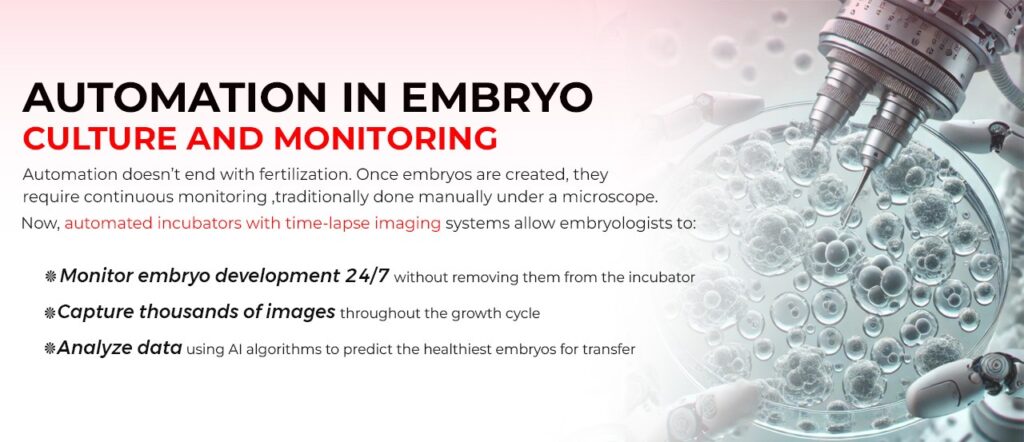
Automation doesn’t end with fertilisation. Once embryos are created, they require continuous monitoring, traditionally done manually under a microscope.
Now, automated incubators with time-lapse imaging systems allow embryologists to:
- Monitor embryo development 24/7 without removing them from the incubator
- Capture thousands of images throughout the growth cycle
- Analyse data using AI algorithms to predict the healthiest embryos for transfer
This method reduces handling, maintains ideal growth conditions, and dramatically improves embryo selection accuracy.
5. AI Meets IVF: The Rise of Smart Embryology
Artificial Intelligence (AI) is one of the most exciting integrations in IVF automation. By analysing thousands of successful and unsuccessful IVF cycles, AI algorithms learn to identify patterns invisible to the human eye.
AI is now being used to:
- Predict embryo viability with higher accuracy
- Optimise hormone stimulation protocols for each patient
- Select sperm with better motility and morphology
- Forecast success probabilities for individual patients
This data-driven approach allows personalised IVF treatments, reducing trial-and-error and improving overall success rates.
6. Benefits of Robotics and Automation in IVF Labs
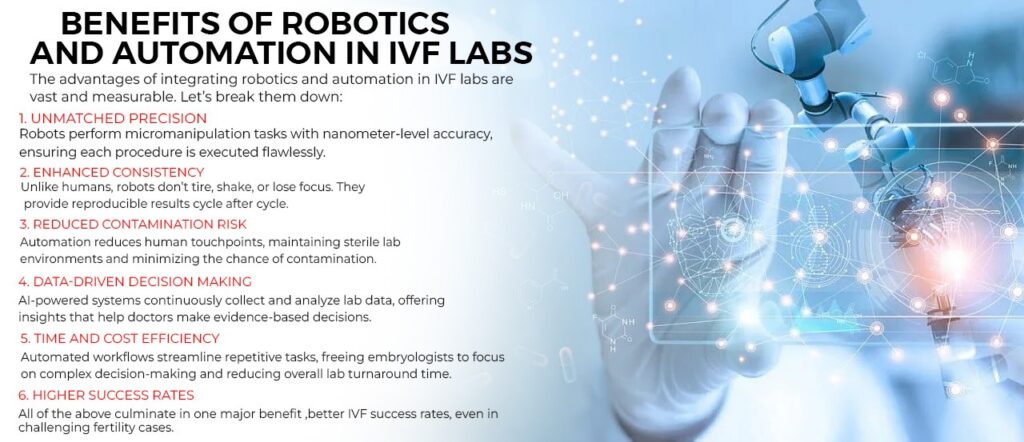
The advantages of integrating robotics and automation in IVF labs are vast and measurable. Let’s break them down:
a. Unmatched Precision
Robots perform micromanipulation tasks with nanometer-level accuracy, ensuring each procedure is executed flawlessly.
b. Enhanced Consistency
Unlike humans, robots don’t tire, shake, or lose focus. They provide reproducible results cycle after cycle.
c. Reduced Contamination Risk
Automation reduces human touchpoints, maintaining sterile lab environments and minimising the chance of contamination.
d. Data-Driven Decision Making
AI-powered systems continuously collect and analyse lab data, offering insights that help doctors make evidence-based decisions.
e. Time and Cost Efficiency
Automated workflows streamline repetitive tasks, freeing embryologists to focus on complex decision-making and reducing overall lab turnaround time.
f. Higher Success Rates
All of the above culminate in one major benefit: better IVF success rates, even in challenging fertility cases.
7. Breakthrough Technologies Powering IVF Automation
Some of the latest innovations that are reshaping IVF labs include:
- Eeva™ Test (Early Embryo Viability Assessment): Uses AI to predict embryo potential based on time-lapse imaging.
- ZyMōt Sperm Separation Device: An automated microfluidic chip that selects the most motile sperm without centrifugation.
- Geri® and EmbryoScope®: Advanced incubators that enable time-lapse imaging with AI integration for embryo grading.
- Hamilton Thorne’s Laser Systems: Automated laser technology for embryo biopsy and zona pellucida thinning.
These technologies represent the marriage of robotics, automation, and AI, making IVF labs smarter and more efficient than ever before.
8. Challenges and Limitations of IVF Automation
Despite the immense potential, full-scale automation in IVF labs still faces a few challenges:
- High setup costs for robotic systems and AI software
- Technical training requirements for embryologists and staff
- Limited accessibility in smaller or resource-limited clinics
- Ethical and regulatory concerns around AI-driven embryo selection
However, as costs drop and awareness grows, these barriers are expected to diminish rapidly in the coming decade.
9. The Human Touch in a Robotic Era
While automation enhances precision, the human element remains irreplaceable. Compassion, empathy, and patient counselling, all essential aspects of fertility treatment, require a human touch.
Moreover, embryologists play a key role in supervising robotic processes, interpreting AI results, and ensuring ethical standards are maintained. The best IVF labs today are those that combine human expertise with robotic accuracy to deliver the best outcomes.
10. The Future of IVF Labs: Toward Fully Automated Fertility Clinics
Imagine an IVF lab where every step, from sample collection to embryo transfer, is robotically managed, monitored by AI, and customised using predictive analytics.
That’s no longer science fiction. The future IVF clinic will likely feature:
- End-to-end automation from gamete handling to embryo transfer
- AI-integrated patient personalisation for medication and stimulation plans
- Cloud-based embryo data tracking for global research collaboration
- Robotic precision systems ensuring zero human error
These innovations promise not only higher pregnancy rates but also broader accessibility, making fertility treatments faster, safer, and more affordable.
11. India’s Role in the IVF Tech Revolution
India has emerged as a hub for affordable and technologically advanced fertility treatments. Leading centres like Imprimis IVF in Srinagar, Jammu, and Bhubaneshwar are already integrating digital and automated systems to improve IVF efficiency.
These clinics combine the latest embryology technology with expert human supervision, delivering world-class fertility care at accessible costs. As automation becomes more mainstream, Indian IVF centres are poised to be global leaders in AI-powered fertility solutions.
12. Conclusion: The New Era of Reproductive Technology
The integration of robotics and automation in IVF labs isn’t just a scientific advancement; it’s a revolution in human hope. By combining robotic precision, AI intelligence, and human empathy, IVF labs are achieving unprecedented success rates and offering couples renewed confidence in their parenthood journey.
Leading the charge in this technological evolution, Imprimis IVF Centres in Srinagar, Jammu, and Bhubaneshwar are among the few in India embracing innovation-driven fertility care. By integrating advanced embryology technologies with human expertise, Imprimis IVF ensures that each couple receives the most precise, personalised, and compassionate treatment possible.
As the future unfolds, Imprimis IVF continues to stand at the forefront, where cutting-edge automation meets heartfelt care, bringing science and emotion together to help countless families achieve their dream of parenthood.
Imprimis IVF Centre Branches: –
Best IVF Centre in Srinagar, Kashmir