

Ovum Pick-Up (OPU): Egg Retrieval, Procedure & Recovery
For weeks, your fertility journey has been measured in millimetres. Your doctor counts follicles on the screen, checks hormone levels, and times your injections carefully. Then one morning, your doctor tells you that your follicles are ready. It is time for ovum pick-up (OPU).
OPU is the day your fertility specialist collects your eggs for IVF.
You may feel relieved and nervous at the same time. The daily injections are almost over. But you may still have questions.
Will egg retrieval hurt? Will you be awake? How long does the procedure take? What will recovery feel like?
Let’s answer these questions clearly. Here is what happens during OPU, what you may feel afterwards, how long recovery usually takes, and when you should contact your doctor.
What is OPU (Ovum Pick-Up)?
OPU stands for ovum pick-up. Doctors also call it egg retrieval, egg pickup, oocyte retrieval, or follicular aspiration.
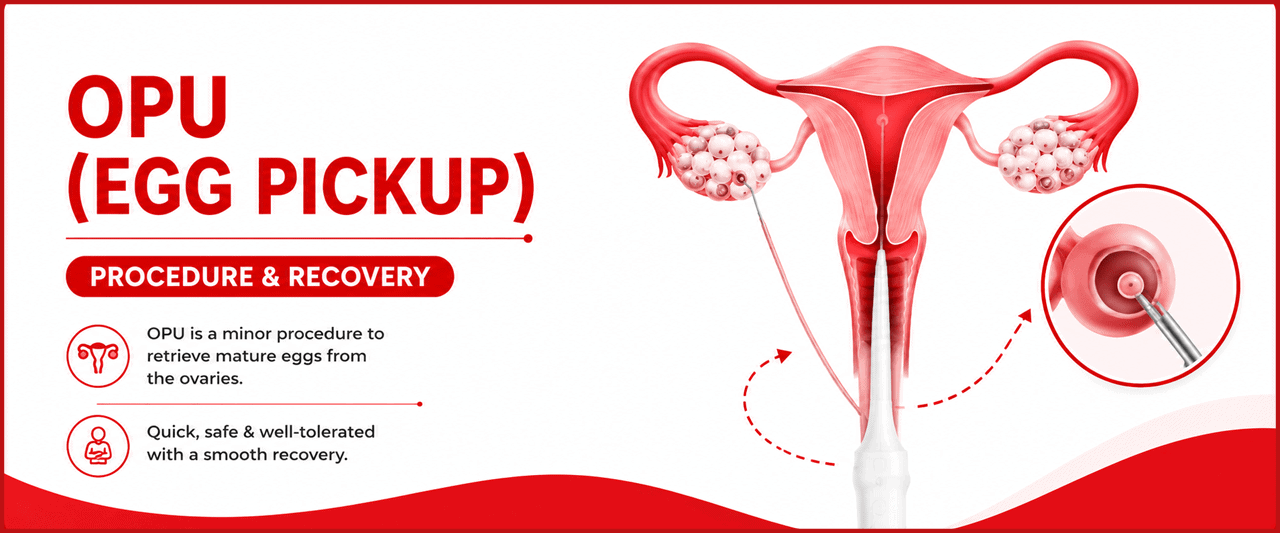
During OPU, your fertility specialist collects mature eggs from your ovaries. The doctor uses an ultrasound scan to see the follicles. A thin needle then passes through the vaginal wall into the ovaries.
The doctor gently draws follicular fluid from the follicles. This fluid may contain an egg. An embryologist checks the fluid under a microscope and identifies the eggs.
OPU does not involve abdominal cuts or stitches. You usually return home on the same day. However, OPU is still a minimally invasive procedure because a needle enters the ovary through the vaginal wall.
Your fertility team uses sedation or anaesthesia to keep you comfortable during the procedure.
Where Does OPU Fit Into Your IVF Journey?
OPU sits in the middle of the IVF process. Understanding the sequence can make the treatment easier to follow.
Ovarian stimulation → Follicular monitoring → Trigger injection → OPU → Fertilisation → Embryo development → Embryo transfer or freezing → Pregnancy test
During ovarian stimulation, hormone injections help several follicles grow. Your doctor then monitors follicle growth through scans and blood tests.
Once the follicles reach the required stage, you receive a trigger shot.
The trigger helps the eggs complete their final maturation. Your doctor then schedules OPU at the appropriate time.
After egg retrieval, the embryology team fertilises the eggs using IVF or ICSI. The embryos then develop in the laboratory.
Your fertility team may transfer an embryo during the same cycle or freeze it for a later transfer.
Why Is the Trigger Shot Timing Important?
Timing matters during an IVF cycle.
Your doctor usually gives the trigger shot when the follicles reach the appropriate size. Many mature follicles measure around 18–20 mm, although the ideal timing depends on your individual treatment plan.
The trigger starts the final stage of egg maturation. Your clinic then schedules egg retrieval about 34–36 hours later.
Doctors choose this timing carefully. They want to collect the eggs before spontaneous ovulation occurs.
If you take the trigger too early or too late, it can affect the retrieval process. That is why you should take the trigger injection at the exact time given by your fertility team.
Set an alarm if necessary. Do not change the timing without speaking to your clinic.
One more point matters here. An hCG trigger can cause a temporary positive pregnancy test. This can happen because the medication contains hCG.
For this reason, do not rely on an early home pregnancy test. Follow the pregnancy test date given by your fertility team.
How Is Ovum Pick-Up Done?
The OPU procedure usually takes place at your fertility centre. Your team will give you specific instructions before the procedure.
Before OPU
Your clinic may ask you to avoid food and drinks for a specific period before sedation or anaesthesia. Follow the fasting instructions given by your doctor or anaesthetist.
Arrange for someone to take you home after the procedure. You should not drive after sedation or anaesthesia.
Your clinic may also ask you to remove jewellery, makeup, nail polish, or contact lenses.
Before the Procedure
You will change into a hospital gown. The anaesthesia team will check your vital signs and place an IV line if required.
Your doctor will explain the procedure before it begins.
During OPU
You will lie on the examination bed with your legs supported. Your doctor will place an ultrasound probe into the vagina.
The ultrasound helps your doctor see the ovaries and follicles clearly.
Your doctor then guides a thin needle through the vaginal wall and into each follicle. Gentle suction removes the follicular fluid.
The embryologist receives the fluid immediately. They examine it under a microscope and identify the eggs.
The procedure usually takes around 15–30 minutes. The exact time depends on the number and location of the follicles.
After OPU, you will rest in a recovery area. Your team will monitor you while the effects of sedation or anaesthesia wear off.
Once you are stable, you can usually go home the same day.
Does Egg Retrieval Hurt?
Most patients do not feel the actual egg retrieval because sedation or anaesthesia helps control discomfort.
Some clinics use conscious sedation. Others may use short general anaesthesia. Your anaesthetist will choose the approach based on your treatment plan and medical needs.
You may notice some discomfort after the procedure.
Common symptoms include:
- Mild to moderate abdominal cramps
- Bloating
- Pelvic discomfort
- Light vaginal spotting
- Tiredness or grogginess
Your clinic can advise you about suitable pain relief.
How Many Eggs Are Retrieved During OPU?
The number of eggs varies from one person to another.
Your age, ovarian reserve, follicle count, and response to stimulation can affect the number of eggs retrieved.
Some patients produce only a few eggs. Others may produce 10, 15, 20, or more.
However, a higher egg number does not automatically mean better IVF results.
Egg quality also matters. Your age and individual fertility factors can affect egg quality.
It is also possible for some follicles to contain no mature egg. This can happen even when the ultrasound shows several follicles.
The embryology team examines the retrieved eggs and identifies which eggs are mature and suitable for fertilisation.
What Happens to the Eggs After OPU?
The embryology team takes the eggs to the laboratory immediately after retrieval.
The team may fertilise the eggs using conventional IVF or ICSI.
During conventional IVF, the laboratory places sperm and eggs together to allow fertilisation.
During ICSI, an embryologist injects a single sperm directly into a mature egg.
The fertilised eggs can then develop into embryos over the next few days.
Many embryos reach the blastocyst stage around day 5 or 6. Your fertility specialist will discuss whether to transfer an embryo or freeze embryos for future use.
In some situations, your doctor may recommend freezing all suitable embryos. This approach can allow your body to recover before a frozen embryo transfer.
Recovery After OPU: What Should You Expect?
Recovery varies from person to person. Your symptoms can also depend on the number of eggs retrieved and your response to ovarian stimulation.
| Timeframe | What You May Experience | What Can Help |
|---|---|---|
| First few hours | Grogginess, mild cramps, light spotting | Rest, drink fluids, and have someone take you home |
| First 24–48 hours | Cramps, bloating, fatigue, light spotting | Rest, hydrate, eat light meals, and follow your doctor’s pain-relief advice |
| Days 3–5 | Symptoms usually start improving | Take short walks and avoid strenuous activity |
| 1–2 weeks | Most symptoms continue to settle | Resume exercise only after your doctor gives you clearance |
Many people feel better within 24–48 hours. Some return to desk work within a day or two.
Your recovery may take longer if you develop significant bloating or other symptoms.
Your next period may arrive around 10–14 days after egg retrieval. It may feel different from your usual period.
Always contact your fertility team if your symptoms become severe or unusual.
OPU Aftercare: Do’s and Don’ts
Your body needs time to recover after egg retrieval.
What You Should Do
- Rest for the first 24–48 hours.
- Drink enough fluids.
- Follow your doctor’s medication instructions.
- Eat light and nutritious meals.
- Wear loose and comfortable clothing.
- Take short, gentle walks when you feel comfortable.
- Attend any follow-up appointments advised by your clinic.
What You Should Avoid
Avoid strenuous exercise for several days or as advised by your doctor. Your ovaries may remain enlarged after stimulation.
Avoid heavy lifting and activities that cause significant pelvic discomfort.
Your doctor may also advise you to avoid sexual intercourse for a specific period after retrieval.
Avoid alcohol and smoking during your recovery.
Ask your clinic before swimming or using a hot tub.
Most importantly, do not ignore symptoms that feel unusual or severe.
When Should You Contact Your Doctor?
Serious complications after OPU are uncommon. However, you should know the warning signs.
Contact your fertility clinic promptly if you experience:
- Severe or worsening abdominal pain
- Significant abdominal swelling or bloating
- Rapid weight gain over a short period
- Reduced urine output
- Difficulty breathing or breathlessness
- Heavy vaginal bleeding
- Fever
- Persistent vomiting
- Severe weakness or dizziness
These symptoms can occur with complications such as ovarian hyperstimulation syndrome (OHSS), bleeding, infection, or other problems.
Early medical assessment can help your fertility team identify and manage complications.
What Is OHSS?
Ovarian hyperstimulation syndrome, or OHSS, can occur when the ovaries respond too strongly to fertility medicines.
The ovaries may become enlarged and fluid can move into the abdomen.
Mild OHSS may cause bloating, abdominal discomfort, nausea, and temporary weight gain. More serious cases need medical attention.
Some patients have a higher risk of OHSS. This includes people with PCOS, a high follicle count, or high hormone levels during stimulation.
Your fertility specialist can use different strategies to reduce the risk.
Depending on your individual situation, your doctor may adjust fertility medicines or use a different trigger medication.
Your doctor may also recommend freezing suitable embryos and planning the embryo transfer for a later cycle.
The right approach depends on your response to treatment and your individual risk factors.
The Imprimis IVF Approach to OPU
At Imprimis IVF, we plan each fertility treatment according to the patient’s individual needs.
Our fertility team monitors follicle development throughout the stimulation process. We also assess factors that may increase the risk of complications such as OHSS.
The fertility and embryology teams work closely during egg retrieval. The embryology team receives the follicular fluid immediately after collection and checks it for eggs.
Our goal is to keep you informed at every stage. We explain the procedure, recovery process, and treatment plan so you know what to expect.
If your ovum pick-up (OPU) is approaching, speak with your fertility specialist about your specific protocol.
Ask about your trigger injection, expected egg count, sedation plan, OHSS risk, and recovery instructions.
Your doctor can provide advice based on your individual fertility treatment and medical history.