

Endometrial Thickness for IVF and Pregnancy: What Is the Ideal Thickness?
If you’re going through IVF, there’s a good chance one number has taken over your thoughts: your endometrial thickness. Seven millimetres. Eight. Is 6.8 a disaster? Should you panic that it’s not double digits?
The internet feeds this anxiety by tossing around a “magic number,” as if a single millimetre decides everything. So let’s be honest and clear from the start: your endometrial thickness genuinely matters, but not in the black-and-white, pass-or-fail way you may be fearing. Here’s what the number really means, what “ideal” actually looks like, and what can be done if your uterine lining is thin during IVF.
What Is Endometrial Thickness?
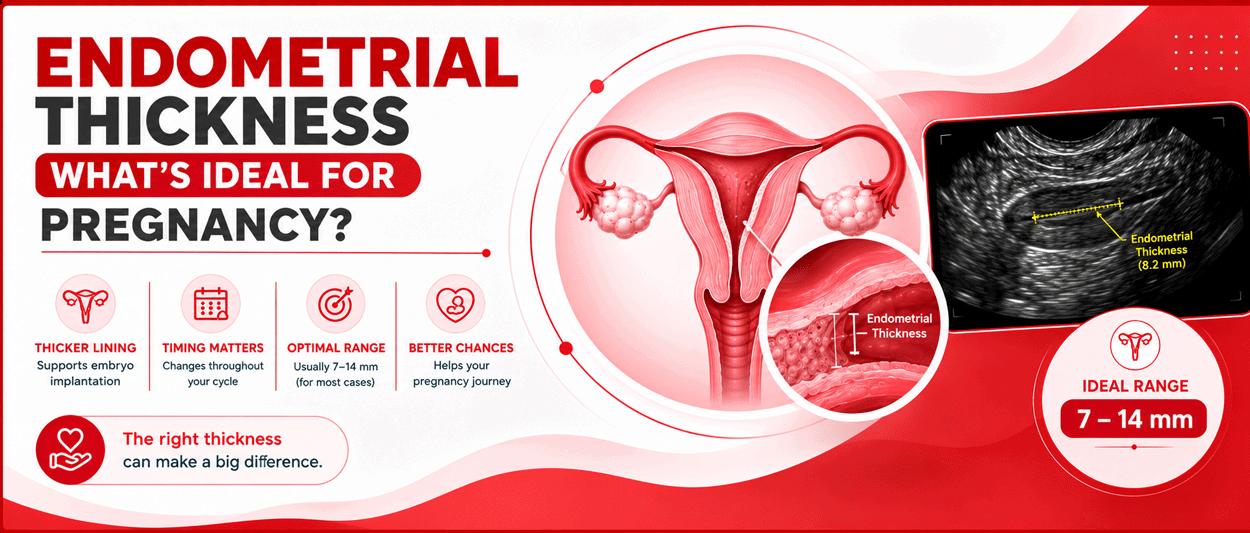
Endometrial thickness refers to the thickness of the lining of your uterus—the soft, blood-rich layer that builds up each month to prepare for embryo implantation.
Think of it as the soil, and the embryo as the seed. Even a healthy embryo may find it harder to implant when the endometrial lining is too thin or not sufficiently receptive.
A healthy endometrium provides a suitable environment for embryo implantation and supports the early stages of pregnancy and placenta development through an adequate blood supply.
That’s why endometrial thickness is carefully assessed before embryo transfer, particularly during IVF treatment. Your fertility specialist considers both the quality of the embryo and the condition of the uterine lining to improve the chances of successful implantation and pregnancy.
Why Does Endometrial Thickness Matter in IVF?
The uterine lining plays an important role in implantation and early pregnancy. During an IVF cycle, the endometrium needs to respond appropriately to hormones and become receptive at the right time for the embryo.
Your fertility specialist may assess:
- Endometrial thickness
- Endometrial pattern
- Blood flow to the uterus
- Hormonal response
- Timing of progesterone exposure
- Embryo quality and developmental stage
- Whether the cycle is fresh or frozen
This means that endometrial thickness for IVF is only one part of the implantation picture.
What Is the Ideal Endometrial Thickness for Pregnancy?
Here’s the practical answer most fertility specialists work with. Before an embryo transfer, they generally want to see a lining of at least 7 mm (some prefer 7.5 or 8 mm), ideally somewhere in the 8–12 mm range, showing a healthy triple-line pattern. That’s the zone where implantation and pregnancy rates tend to be strongest.
A simple way to picture it:
| Endometrial Thickness | General Interpretation |
|---|---|
| Below 6 mm | Considered very thin; success rates may decrease noticeably |
| 6–7 mm | Borderline; many clinics prefer to improve the lining before transfer |
| 7–8 mm | Common minimum range considered before embryo transfer |
| 8–12 mm | A range many fertility specialists aim for |
| Above 14–15 mm | Usually not a problem, but may occasionally require further assessment |
If your reading sits in that 8–12 mm range with a good endometrial pattern, that’s reassuring. But if it doesn’t, don’t panic, because the numbers are only part of the story.
Is 7 mm Endometrial Thickness Good for IVF?
A 7 mm endometrial lining is often considered an acceptable minimum by many fertility clinics, particularly when the endometrial pattern looks favourable and other factors are reassuring.
However, there is no universal cut-off at which IVF suddenly changes from “possible” to “impossible.”
This is why your fertility specialist may recommend proceeding with embryo transfer at 7 mm in one situation but suggest additional preparation at 6 mm or less in another.
Is 8 mm Endometrial Thickness Good for Embryo Transfer?
Yes. An endometrial thickness of 8 mm is generally considered a favourable measurement for embryo transfer, especially when the lining has a good trilaminar or triple-line appearance.
Many IVF specialists consider approximately 8–12 mm a comfortable range, but the ideal thickness can vary depending on the individual patient and type of treatment cycle.
Is 6.8 mm Endometrial Thickness Too Thin?
A measurement of 6.8 mm does not mean that IVF cannot work.
The difference between 6.8 mm and 7.0 mm is extremely small and may partly reflect normal measurement variation during ultrasound. Your doctor will also consider the endometrial pattern, blood flow, hormonal environment, embryo quality, and timing of embryo transfer.
So, don’t let a decimal point convince you that your cycle has failed.
The Truth: There’s No Single Magic Number for Endometrial Thickness
This is the part most pages leave out, and it’s the part that should calm you down.
Despite decades of study, there is no universally agreed “ideal” endometrial thickness. Pregnancies happen below the usual thresholds; the rates may be lower, but they aren’t zero.
A reading of 6.8 mm is not categorically worse than 7.0 mm. A difference that small can reflect the angle of the ultrasound scan or measurement variation rather than a meaningful biological change.
And thickness is only one marker of a receptive endometrium. The pattern and blood flow matter too.
The type of cycle matters as well. In fresh IVF cycles, large studies show live-birth rates climbing as the lining thickens up to around 10–12 mm. In frozen embryo transfer cycles, the benefit tends to plateau earlier, after about 7–10 mm, and some frozen-cycle studies find no clear effect of thickness at all. For natural conception, the evidence is even less settled, since most research comes from IVF.
So yes, aim for a healthy lining. But don’t let a single decimal point steal your peace. The number is a guide your doctor uses in context—not a verdict on your chances.
How Endometrial Thickness Changes During the Menstrual Cycle
Your endometrium isn’t a fixed thickness; it grows and sheds every month, which is why when it is measured matters.
Just after your period, the uterine lining is thin because it has recently shed. Through the first half of the cycle, rising estrogen builds the lining, thickening it steadily.
Around ovulation, it typically reaches roughly 8–12 mm and takes on its receptive triple-line or trilaminar appearance.
After ovulation, progesterone takes over and matures the lining, making it softer and nutrient-rich—the ideal surface for an embryo.
In IVF, medications simply mimic this natural rhythm: estrogen builds the endometrium, while progesterone prepares it for embryo implantation.
That’s why your lining is measured at specific points around trigger time in a fresh IVF cycle or during preparation for a frozen embryo transfer (FET).
Endometrial Thickness During IVF Treatment
During IVF, your fertility team regularly monitors the uterine lining to determine whether it is developing appropriately before embryo transfer.
Depending on your IVF protocol, your doctor may use:
- Estrogen tablets, patches, or other forms of estrogen
- Ultrasound monitoring
- Hormonal blood tests when required
- Progesterone supplementation
- Natural or modified-natural cycle monitoring
- Medicated frozen embryo transfer protocols
The goal is not simply to make the lining thicker. The goal is to create a receptive endometrium at the correct time for embryo implantation.
Why the Trilaminar or Triple-Line Endometrial Pattern Matters
You’ll often hear the word “trilaminar,” “triple-line,” or “three-line pattern.”
It describes how a receptive lining can look on ultrasound near ovulation: three distinct layers, like a faint sandwich. It’s a reassuring sign that the endometrium has developed properly under estrogen.
This is why an experienced fertility doctor never reads endometrial thickness in isolation.
A lining with a favourable thickness and a trilaminar pattern may be reassuring. A lining that reaches a particular number but shows a less favourable pattern may require a more individualised assessment.
Pattern and thickness are read together, which is another reason a single figure on your ultrasound report doesn’t tell the whole story.
What Causes a Thin Endometrium?
If your lining is stubbornly thin, there may be an underlying reason, and finding the cause is the first step toward deciding what to do next.
Common causes of a thin endometrium include:
- Low estrogen levels
- Naturally thin endometrial lining
- Age-related changes
- Asherman’s syndrome or intrauterine adhesions
- Previous D&C or uterine surgery
- Previous uterine infection
- Chronic endometritis
- Genital tuberculosis
- Poor uterine blood flow
- Previous pelvic radiation
- Previous use of anti-estrogen medicines such as clomiphene
Genital tuberculosis is particularly relevant when evaluating infertility in India because it can affect the uterus and reproductive organs and may contribute to an abnormal or thin endometrium.
Identifying the cause matters because the appropriate treatment depends entirely on why the lining is thin.
Thin Endometrium and IVF: Can It Be Improved?
Often, yes—and this is the hopeful part.
A thin endometrial lining during IVF is a challenge to work on, not necessarily a dead end.
Depending on the cause, your fertility specialist has several options.
Optimising Estrogen Treatment
Your doctor may consider adjusting the estrogen protocol, including a higher dose, longer preparation time, or a different route such as vaginal or transdermal estrogen.
The exact approach depends on your medical history and response to treatment.
Improving Uterine Blood Flow
Some fertility specialists may consider treatments intended to improve blood flow to the uterus, including options such as vaginal sildenafil, low-dose aspirin, or pentoxifylline with vitamin E in selected patients.
However, these treatments are not appropriate for everyone and should only be used when recommended by your fertility specialist.
Treating Infection or Genital Tuberculosis
If an infection or genital tuberculosis is responsible for changes in the endometrium, identifying and treating the underlying condition is essential.
Hysteroscopy for Uterine Adhesions
If scar tissue or intrauterine adhesions are the problem, hysteroscopy may allow the doctor to examine the uterine cavity and remove adhesions when appropriate.
Regenerative Treatments for Thin Endometrium
For difficult or persistent cases, some fertility centres use regenerative approaches such as platelet-rich plasma (PRP) placed into the uterus or G-CSF.
These approaches continue to be studied, and evidence varies between treatments and patient groups. Your fertility specialist can explain whether such options are appropriate for your individual situation.
Should You Transfer an Embryo With a Thin Endometrium?
This is an important decision that should be individualised.
If your lining won’t reach a satisfactory thickness in a given cycle, your fertility specialist may recommend freezing the embryos and preparing the uterus for a later frozen embryo transfer rather than proceeding with an embryo transfer under less favourable conditions.
A cancelled or postponed transfer can feel like a setback, but it may sometimes allow the team to optimise the endometrium before transferring an embryo.
The decision depends on your individual circumstances, including endometrial thickness, pattern, hormonal levels, embryo quality, previous treatment history, and the type of IVF cycle.
What If the Endometrial Lining Is Too Thick?
Far fewer people worry about this, and rightly so—a thicker lining is usually a good sign, not a bad one.
A generously thick, trilaminar lining generally means your uterus has responded well.
Occasionally, a very thick endometrium, particularly above roughly 14–15 mm, may prompt your doctor to take a closer look and rule out conditions such as an endometrial polyp or other abnormalities.
But a thicker lining is not automatically a problem, and your doctor will interpret the measurement in the context of your ultrasound findings and treatment cycle.
Endometrial Thickness and Embryo Implantation: The Bigger Picture
It’s easy, in the intensity of IVF, to let one number carry all your hope and fear. Try to resist that.
A successful pregnancy depends on many things working together:
- Embryo quality and genetics
- Endometrial thickness
- Endometrial pattern and receptivity
- Timing of embryo transfer
- Hormonal preparation
- Uterine health
- Age and reproductive factors
- Overall health
- Sperm and egg factors
A good endometrial lining can improve the chances of implantation, but it doesn’t guarantee pregnancy on its own.
Similarly, a slightly thin lining can reduce the chances in some circumstances without making pregnancy impossible.
The healthiest way to hold this is the way your fertility specialist does: as one important and potentially adjustable factor among several, not the single line between success and failure.
Frequently Asked Questions About Endometrial Thickness
What is the best endometrial thickness for IVF?
Many fertility specialists aim for an endometrial thickness of around 8–12 mm with a favourable pattern before embryo transfer. However, there is no single universally accepted ideal thickness.
Is 7 mm endometrial thickness enough for embryo transfer?
A lining of 7 mm may be acceptable for embryo transfer in many cases, particularly when the pattern and other clinical factors are favourable. Your fertility specialist will make the decision based on your complete treatment picture.
Is 6 mm endometrial thickness too thin for IVF?
A 6 mm lining is generally considered thin, and many clinics may try to improve it before embryo transfer. However, pregnancy can still occur with a thin lining, so 6 mm does not automatically mean IVF will fail.
Is 6.8 mm endometrial thickness good?
6.8 mm is close to the commonly used 7 mm threshold. It should not be viewed as a pass-or-fail number. Ultrasound measurement variation and the endometrial pattern also matter.
Is 8 mm a good lining for IVF?
Yes. 8 mm is generally considered a favourable endometrial thickness for embryo transfer, particularly when the lining has a good trilaminar pattern.
What is a trilaminar endometrium?
A trilaminar or triple-line endometrium is an ultrasound appearance showing three distinct layers. It is commonly considered a favourable sign during the period leading up to ovulation or embryo transfer.
Can a thin endometrium be treated?
In many cases, doctors can identify factors contributing to a thin lining and address them. Treatment depends on the underlying cause and may include hormonal optimisation, treating infection, hysteroscopy for adhesions, or selected additional therapies.
The Imprimis IVF Approach to Endometrial Thickness
At Imprimis IVF, your lining is assessed the way it should be: thickness and pattern, read in the full context of your cycle, not reduced to a single number on a screen.
When a lining runs thin, the focus is on finding the cause—including the ones that matter in India, such as infection, tuberculosis, or scar tissue—and treating it directly, with estrogen strategies, blood-flow support, hysteroscopy, or regenerative options where they’re appropriate.
And a transfer is never forced into an unready uterus if your best chance means optimising the lining first and transferring later; that’s the path taken.
As always, what your scan shows is explained to you plainly, so a number on a report becomes understanding rather than worry.
If you’ve been told your endometrial lining is thin, or you simply want to understand your own numbers, that’s exactly the kind of question a conversation with a fertility specialist can settle with a plan built around your body.
Important: Endometrial thickness is only one factor affecting IVF outcomes. Your fertility specialist should interpret your ultrasound findings alongside your treatment protocol, hormone levels, embryo quality, medical history, and other individual factors.