

Advanced Genetic Testing & Non-Invasive Screening in IVF
Advancements in modern fertility care have completely transformed how couples approach assisted reproduction. Among these breakthroughs, advanced genetic testing and non-invasive screening in IVF have become two of the most powerful tools for improving pregnancy outcomes, reducing risks, and ensuring healthier babies.
Whether you’re planning IVF or simply exploring fertility options, this guide will help you understand how these technologies work, why they matter, and how they’re reshaping the future of reproductive medicine.
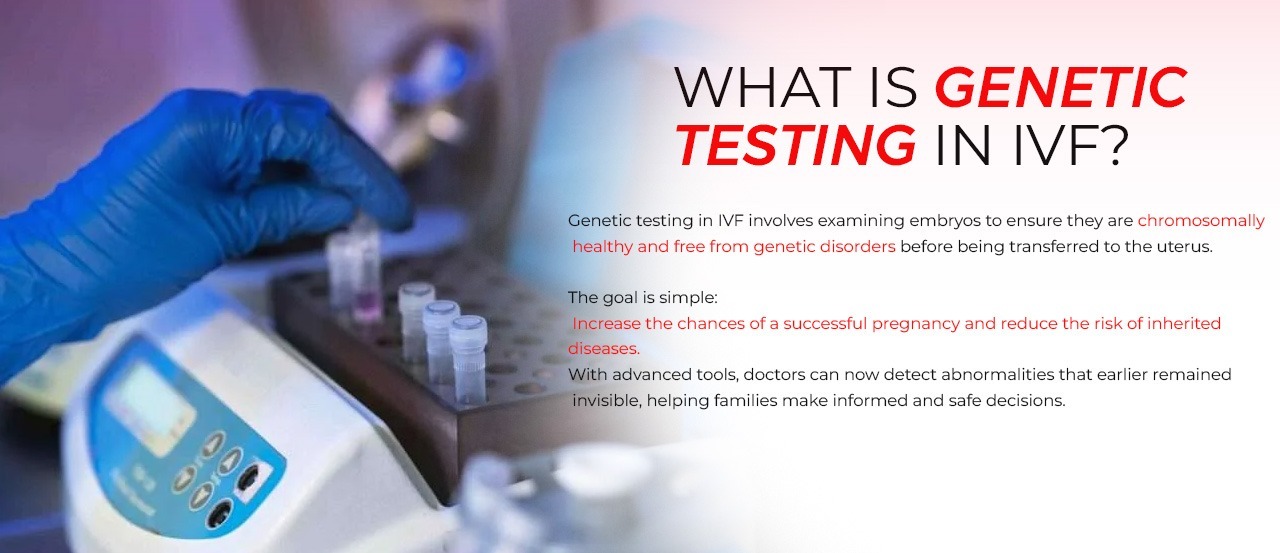
What Is Genetic Testing in IVF?
Genetic testing in IVF involves examining embryos to ensure they are chromosomally healthy and free from genetic disorders before being transferred to the uterus.
The goal is simple:
Increase the chances of a successful pregnancy and reduce the risk of inherited diseases.
With advanced tools, doctors can now detect abnormalities that earlier remained invisible, helping families make informed and safe decisions.
Why Genetic Testing Matters More Than Ever

In today’s world, genetic disorders are more detectable—and preventable—than any time in history.
Reasons why genetic testing is becoming essential include:
- Improved IVF success rates
- Reduced risk of miscarriage
- Higher chance of a chromosomally normal pregnancy
- Identification of hereditary diseases
- Better embryo selection and fewer IVF cycles needed
Especially for couples with repeated IVF failures or unexplained miscarriages, advanced testing can be life-changing.
Types of Advanced Genetic Testing in IVF
Let’s break down the most widely used and trusted genetic tests available today.
1. Preimplantation Genetic Testing for Aneuploidy (PGT-A)
PGT-A checks if an embryo has the correct number of chromosomes.
Normal embryos have 46 chromosomes. If the number is incorrect (called aneuploidy), the embryo may fail to implant or lead to miscarriage.
PGT-A helps:
- Improve implantation success
- Reduce miscarriage rates
- Increase the chance of a healthy pregnancy
- Avoid transferring chromosomally abnormal embryos
- Preimplantation Genetic Testing for Monogenic Diseases (PGT-M)
PGT-M is used when one or both parents are carriers of inherited single-gene disorders, such as:
- Thalassemia
- Cystic Fibrosis
- Huntington’s Disease
- Sickle Cell Anaemia
- Muscular Dystrophy
Here, DNA from the embryo is analysed for specific mutations, ensuring only healthy embryos are transferred.
3. Preimplantation Genetic Testing for Structural Rearrangements (PGT-SR)
PGT-SR is for couples who carry balanced translocations or chromosomal structural abnormalities.
Without this testing, embryos may develop:
- Missing or extra chromosomal segments
- Structural defects
- Increased chances of miscarriage
PGT-SR identifies embryos that are chromosomally balanced and suitable for transfer.
What Is Non-Invasive Screening in IVF?
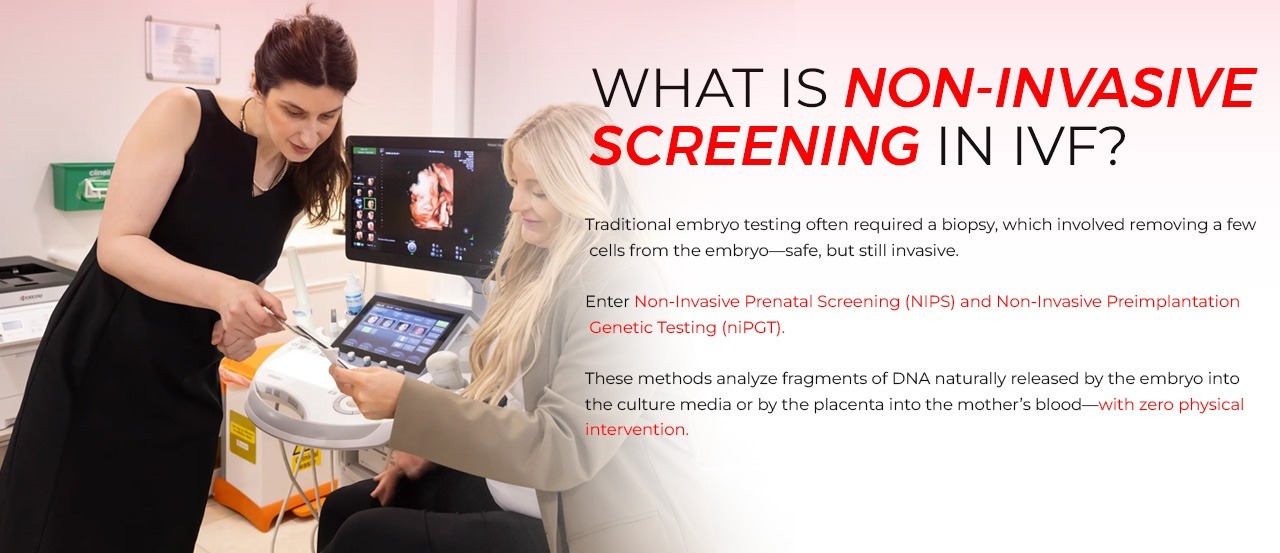
Traditional embryo testing often required a biopsy, which involved removing a few cells from the embryo—safe, but still invasive.
Enter Non-Invasive Prenatal Screening (NIPS) and Non-Invasive Preimplantation Genetic Testing (niPGT).
These methods analyse fragments of DNA naturally released by the embryo into the culture media or by the placenta into the mother’s blood, with zero physical intervention.
Types of Non-Invasive Screening Used in IVF
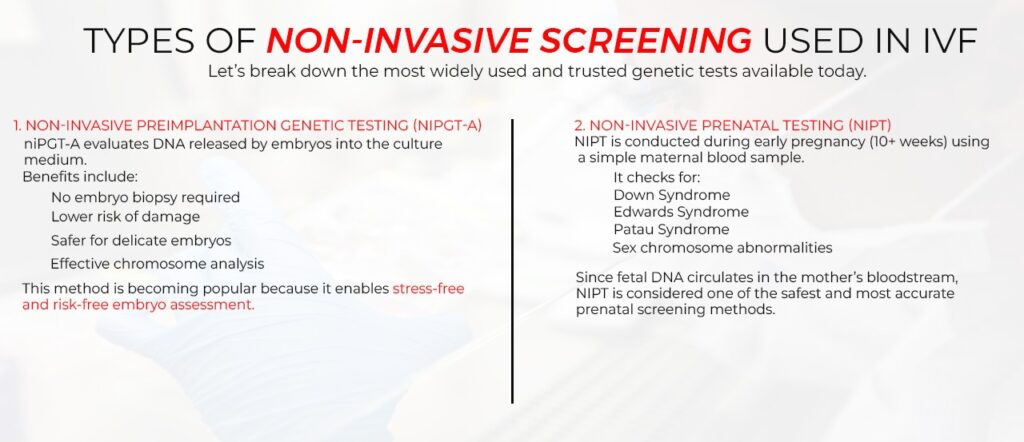
1. Non-Invasive Preimplantation Genetic Testing (niPGT-A)
niPGT-A evaluates DNA released by embryos into the culture medium.
Benefits include:
- No embryo biopsy required
- Lower risk of damage
- Safer for delicate embryos
- Effective chromosome analysis
This method is becoming popular because it enables stress-free and risk-free embryo assessment.
2. Non-Invasive Prenatal Testing (NIPT)
NIPT is conducted during early pregnancy (10+ weeks) using a simple maternal blood sample.
It checks for:
- Down Syndrome
- Edwards Syndrome
- Patau Syndrome
- Sex chromosome abnormalities
Since fetal DNA circulates in the mother’s bloodstream, NIPT is considered one of the safest and most accurate prenatal screening methods.
How Non-Invasive Tests Are Changing IVF Success Rates
These tests are revolutionising IVF in several ways:
- Safer for Embryos
No physical biopsy means zero damage or developmental interference.
- Better Accuracy
Advanced sequencing technology offers deeper chromosomal insights.
- Higher Pregnancy Rates
Correct embryo selection leads to better implantation chances.
- Lower Emotional and Financial Stress
Fewer IVF cycles + higher success = reduced cost and anxiety for couples.
- Early Detection of Genetic Risks
Parents can make informed decisions long before pregnancy progresses.
Who Should Consider Genetic Testing & Non-Invasive Screening?
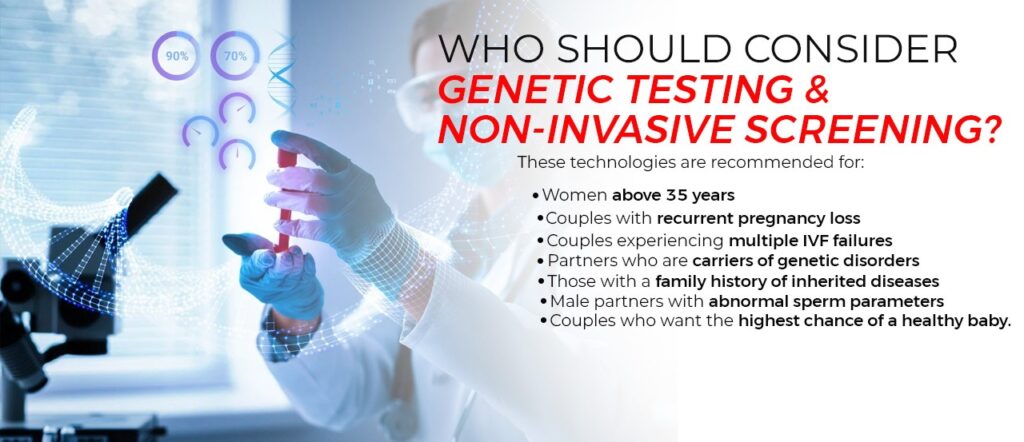
These technologies are recommended for:
- Women above 35 years
- Couples with recurrent pregnancy loss
- Couples experiencing multiple IVF failures
- Partners who are carriers of genetic disorders
- Those with a family history of inherited diseases
- Male partners with abnormal sperm parameters
- Couples who want the highest chance of a healthy baby.
The Step-By-Step Process of Genetic Testing in IVF
Here’s what typically happens:
1. Ovarian stimulation
Hormonal medications help produce multiple mature eggs.
2. Egg retrieval
A short, minimally invasive procedure collects the eggs.
3. Fertilisation (IVF or ICSI)
Sperm fertilise the eggs in a controlled lab environment.
4. Embryo development
Embryos grow for 5–6 days to the blastocyst stage.
5. Biopsy or Non-Invasive Testing
- PGT: A few cells are safely taken from the embryo
- niPGT: DNA in the embryo’s culture fluid is analysed
6. Genetic analysis
Sophisticated sequencing checks for abnormalities.
7. Selection of healthiest embryo(s)
Doctors choose embryos with the highest potential.
8. Embryo transfer
A healthy embryo is transferred into the uterus.
9. Pregnancy test
Blood test confirms pregnancy after 10–14 days.
Are Genetic Tests Safe for the Embryo?
Yes.
Both PGT and non-invasive screening are extensively validated, safe, and recommended by global fertility authorities.
With niPGT, safety increases even more because there is:
- No cell removal
- No physical contact with the embryo
- No developmental risk
This makes it ideal for couples who want precision without intervention.
Limitations to Keep in Mind
Even though these technologies are powerful, there are certain limitations:
- They do not guarantee a baby, but only improve chances
- Not all abnormalities can be detected
- niPGT accuracy varies between clinics
- Costs may be higher than basic IVF
However, for most couples, the benefits significantly outweigh the limitations.
Cost of Advanced Genetic Testing in IVF
Costs vary depending on:
- Clinic
- Type of testing (PGT-A, PGT-M, niPGT, etc.)
- Technology used
- Number of embryos tested
On average:
- PGT-A: Higher cost but widely used
- PGT-M/SR: Advanced and specific to genetic conditions
- niPGT: Increasingly affordable with time
While the upfront cost is higher, many couples find that it reduces overall IVF expenses by minimising the number of failed cycles.
Future of IVF: A Blend of Genetics, AI & Personalisation
The next era of IVF will merge:
- AI-driven embryo selection
- Non-invasive genetic insights
- Real-time embryo monitoring
- Precision medicine based on parental genetics
This means IVF will become:
- More successful
- More accurate
- Less invasive
- More affordable
- More personalized
Conclusion
Advanced genetic testing and non-invasive screening in IVF represent a powerful leap forward in modern fertility care. These technologies not only help identify healthy embryos but also dramatically increase pregnancy success rates while minimising emotional, financial, and medical risks for couples.
At centres like Imprimis IVF with branches in Srinagar, Jammu, and Bhubaneswar, these innovations are already transforming patient journeys. With access to advanced tools such as niPGT, PGT-A, and NIPT, families receive safer, more accurate, and more personalised fertility solutions under the guidance of experienced specialists.
Whether you’re beginning your IVF journey or exploring your options, understanding these advancements gives you greater control, confidence, and clarity. And with trusted centres like Imprimis IVF bringing world-class technology closer to home, hopeful parents can now take confident steps toward a healthier, safer, and more successful pregnancy.
Imprimis IVF Centre Branches: –
Best IVF Centre in Srinagar, Kashmir